


"95% of a typical workforce do not understand its organisation's strategy"
Kaplan & Norton: Balanced Scorecard k
"90% of organisations fail to execute their strategies successfully"
Kaplan & Norton: Balanced Scorecard k
"60% of organisations do not link strategy to budgeting"
Kaplan & Norton: Balanced Scorecard k


Supporting Businesses On A Journey To Excellence
"Grow Your Business By Setting Strategic Goals Which Are Consistently Achieved By Employees."
Most Businesses Fail To Achieve Their Strategic Goals Consistently
The best strategies are worthless unless they can be executed successfully. But businesses are notoriously unsuccessful at achieving their strategic goals.
For example, in a global survey conducted amongst 1,526 business professionals by the Human Resource Institute and commissioned by the American Management Association:
The best strategies are worthless unless they can be executed successfully. But businesses are notoriously unsuccessful at achieving their strategic goals.
For example, in a global survey conducted amongst 1,526 business professionals by the Human Resource Institute and commissioned by the American Management Association:
a mere 3% of respondents said their organisations are "very successful" and
62% of participants viewed their organisations as only moderately successful or worse


at executing strategies.


Because Strategy Is Typically Developed By A Few, But Executed By Many
Typically strategy is developed by management, but ultimately it is executed by employees, generally working in teams. This results in a gap between what management require and what really gets done on the ground - the so-called execution gap.
The execution gap arises because of a number of reasons:
The result is that employees spend their time on those activities which are urgent and not on those activities which are important because they have the greatest impact on the business.
And employees are at different levels and from different areas in the business. As a result, management often talk about the existence of silos in the business. However, in many businesses employees operate not only from silos but from organisational cages where interaction may suffer from a number of problems such as lack of communication, conflict and selective information sharing, contributing to the execution gap.
Getting employees to work together successfully in order to execute strategy, is not simple. They have different backgrounds, values, training, motivations and priorities and all have their own understanding of what to do and how to get it done.
As a result, many strategies fail badly in terms of actually guiding a business and strategic goals are often missed because of changing priorities, protection of own positions and daily crisis management, amongst others.
The Responsibility Of Owners And Management
However, W. Edwards Deming, the management guru, taught that anytime the majority of people behave in a particular way most of the time, the people are not the problem. Rather, the problem is inherent in the system. Therefor, owners and management should not blame employees, but should accept full responsibility to close the execution gap.
If owners and management want to close the execution gap, they have to create an environment where things are done differently. Unless the ways of the past are changed, the results in the future will be the same.
Typically strategy is developed by management, but ultimately it is executed by employees, generally working in teams. This results in a gap between what management require and what really gets done on the ground - the so-called execution gap.
The execution gap arises because of a number of reasons:
The Daily Flood Of Tasks And Issues... Or The Business Of Being Busy
Employees are flooded with daily tasks and issues to be attended to. The result is that employees spend their time on those activities which are urgent and not on those activities which are important because they have the greatest impact on the business.
The Fragmented Business... About Silos And Cages
Strategies are usually developed by few (management), but executed by many (all employees). And employees are at different levels and from different areas in the business. As a result, management often talk about the existence of silos in the business. However, in many businesses employees operate not only from silos but from organisational cages where interaction may suffer from a number of problems such as lack of communication, conflict and selective information sharing, contributing to the execution gap.
The Self-seeking Employee... The Challenge Of Different Values, Training, Believes And Behaviours
Most worthwhile strategies require a significant change in employee behaviour to be executed successfully. Getting employees to work together successfully in order to execute strategy, is not simple. They have different backgrounds, values, training, motivations and priorities and all have their own understanding of what to do and how to get it done.
As a result, many strategies fail badly in terms of actually guiding a business and strategic goals are often missed because of changing priorities, protection of own positions and daily crisis management, amongst others.
The Responsibility Of Owners And Management
However, W. Edwards Deming, the management guru, taught that anytime the majority of people behave in a particular way most of the time, the people are not the problem. Rather, the problem is inherent in the system. Therefor, owners and management should not blame employees, but should accept full responsibility to close the execution gap.
If owners and management want to close the execution gap, they have to create an environment where things are done differently. Unless the ways of the past are changed, the results in the future will be the same.
"85% of executive teams spend less than 1 hour per month discussing strategy"
Kaplan & Norton: Balanced Scorecard k

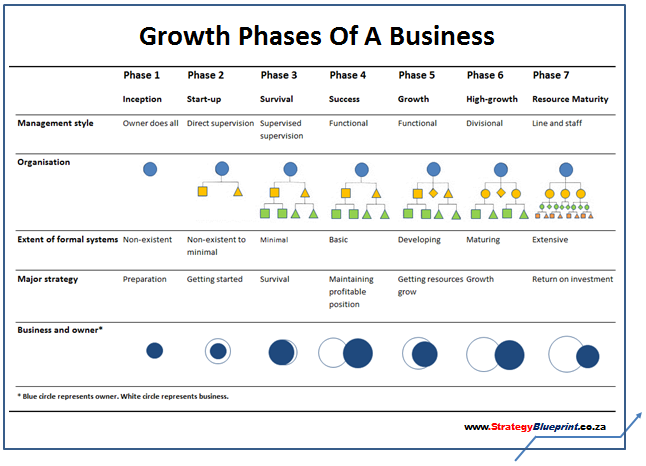
The Growth Phases Of A Business
A business goes through different growth phases during its lifetime.
A business goes through different growth phases during its lifetime.
The specific issues inherent in the different growth phases of a business require specific strategies to address those issues.
Free Consultation
Most businesses have unresolved issues or unmet goals which impede growth and result in millions of Rands in wasted expenses or lost income.
StrategyBlueprint Consulting offers a limited number of free consultations to businesses where we work with owners and management on an existing issue (either a challenge or an opportunity) which is not being addressed or a goal which is not being achieved in the business.
If:
Most businesses have unresolved issues or unmet goals which impede growth and result in millions of Rands in wasted expenses or lost income.
StrategyBlueprint Consulting offers a limited number of free consultations to businesses where we work with owners and management on an existing issue (either a challenge or an opportunity) which is not being addressed or a goal which is not being achieved in the business.
The format and length of the consultation is agreed in advance. Travel and accommodation cost outside Gauteng is charged at actual cost and is payable in advance.
At the end of the consultation you will have a clear understanding of the actions you need to take to address the issue or achieve the goal. You will not only know "what" to do, but also "how" to do it.
The consultation is free and it places you under no obligation.
Qualification CriteriaAt the end of the consultation you will have a clear understanding of the actions you need to take to address the issue or achieve the goal. You will not only know "what" to do, but also "how" to do it.
The consultation is free and it places you under no obligation.
If:

you have a strategic issue or goal which is worth at least R500,000 per year in cost savings or additional income if it is properly addressed,

you are the CEO, owner or manager of a business or a team in a business;
your team consist of at least 5 people reporting to you;
the business has been in operation for more than three years; and


you qualify to request a free consultation.
What Do You Have To Do Next?
If you qualify for a FREE consultation (see Qualification Criteria above), please click here.
What Do You Have To Do Next?
If you qualify for a FREE consultation (see Qualification Criteria above), please click here.
The Consequences Of Failure
Failure to address strategic issues or meet strategic goals has a severe impact on the business. First and foremost it impedes the growth of the business, but it also reduces the probability of getting funding when required or to sell the business at its best potential value.
It is therefor crucial that owners and management should address issues in time and not wait until they are forced to do so by circumstances.
Failure to address strategic issues or meet strategic goals has a severe impact on the business. First and foremost it impedes the growth of the business, but it also reduces the probability of getting funding when required or to sell the business at its best potential value.
It is therefor crucial that owners and management should address issues in time and not wait until they are forced to do so by circumstances.
